NYAS Junior Academy / proposal
A proposed EEG pipeline to track concentration during speech therapy for people with Moebius syndrome.
Role
Computational lead
Program
NYAS Junior Academy
Data
Open-access EEG
Status
Proposed framework
The Real Problem
People with Moebius syndrome live with facial paralysis, and speech therapy is slow work. Our team wanted a way to see when a patient is concentrating during a session.
Finding the Fix
As computational lead on our NYAS Junior Academy team, I designed the signal pipeline using open-access EEG data.
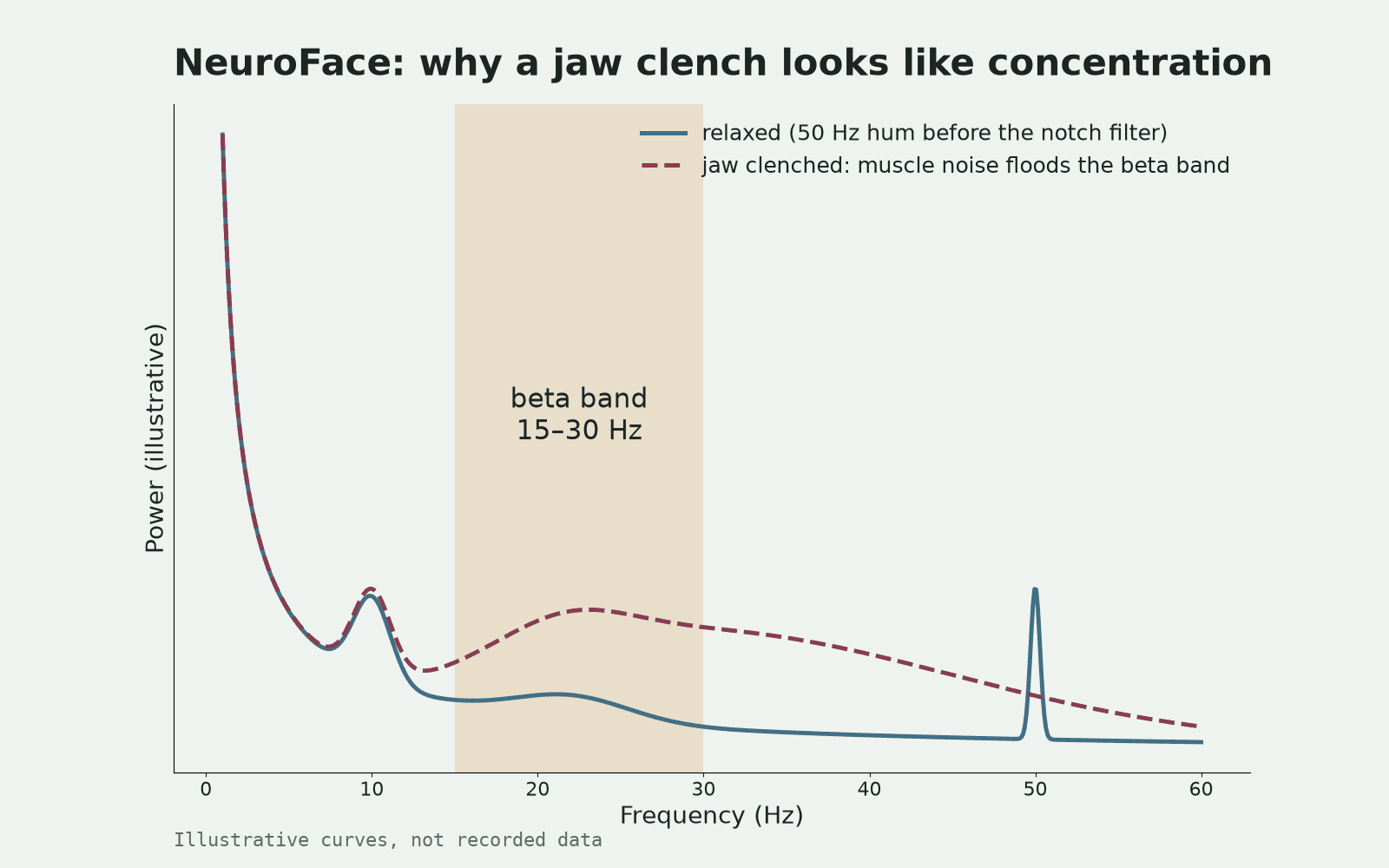
Cleaning: a notch filter removed 50 Hz mains hum, and ICA separated out eye blinks.
Signal: we tracked focused effort in the 15 to 30 Hz beta band.
What Actually Happened
The power spectrum showed a problem. Whenever a subject clenched their jaw, muscle spikes flooded the beta band, so someone gritting their teeth against a tight headset looked exactly like someone concentrating hard. The classifier was rewarding discomfort as determination.
I convinced the team to stop claiming clinical use, documented this as our main limitation, and proposed an extra reference electrode to separate muscle noise before feature extraction.
What I Learned
A good benchmark can hide a bad signal. Look at the raw spectrum before trusting the score.