Production / crates.io
Delay-tolerant onion routing in Rust, with a crash-safe write-ahead log published on crates.io.
Role
Author, protocol design and Rust build
Fault trials
39,855 on Hermes
Stack
Rust, append-only WAL, CRC32C
Kill test
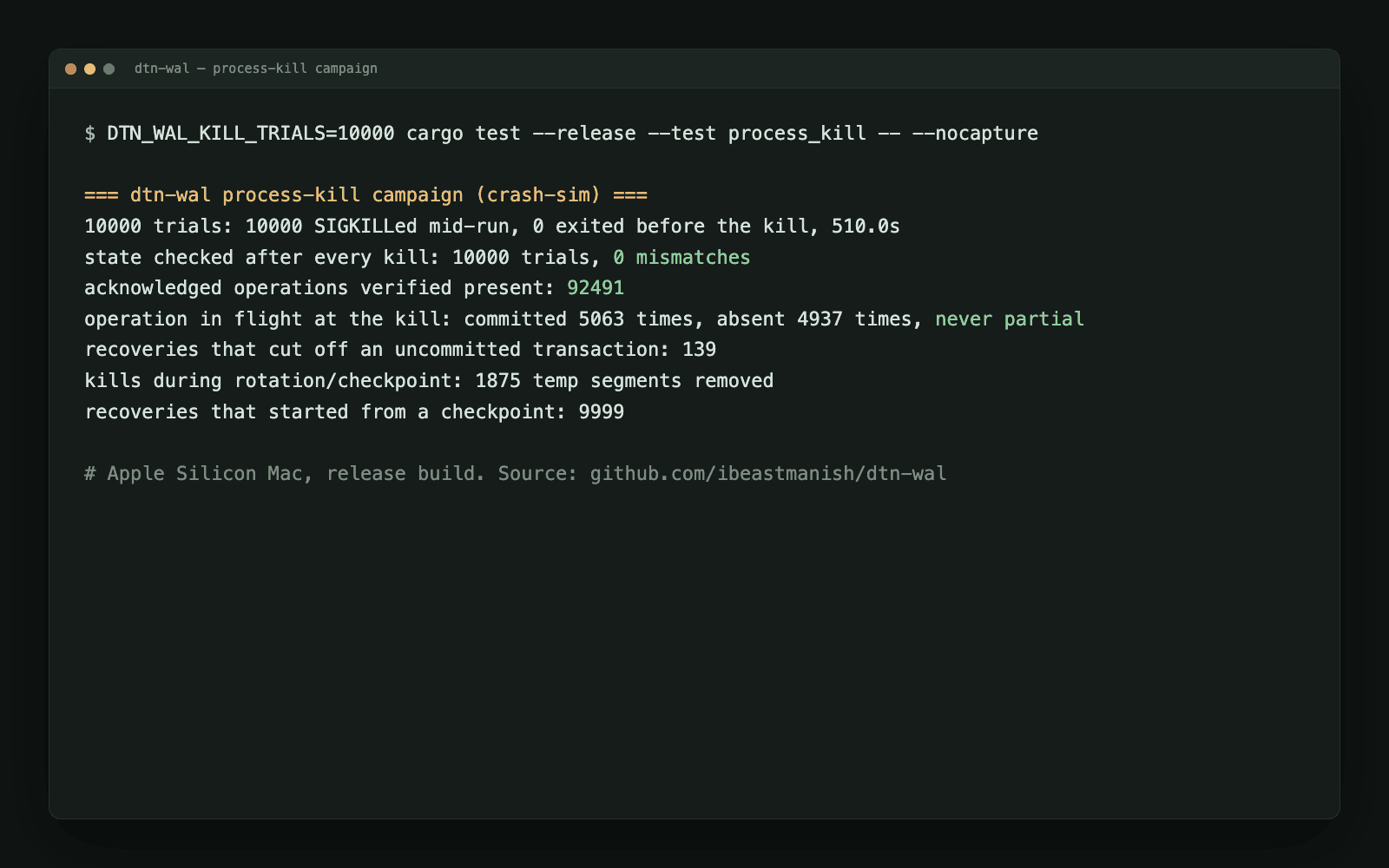
10,000 SIGKILLs, 0 mismatches
The Real Problem
Most networking assumes a path exists from end to end. On long-range radio meshes and links that drop for minutes at a time, that assumption breaks.
When there is no path, a message needs somewhere safe to wait until the next hop appears, and it must survive the device crashing while it waits.
Finding the Fix
Hermes is a delay-tolerant onion-routing protocol written in memory-safe Rust. Messages are stored and forwarded hop by hop over a sub-GHz radio mesh, so a broken link delays delivery instead of losing data.
Store and forward: every hop keeps custody of a message until the next hop confirms it.
Crash-safe storage: dtn-wal, an append-only write-ahead log with CRC32C-checked frames, keeps queued messages intact across crashes and restarts.
What Actually Happened
I evaluated the protocol across 39,855 fault trials.
The storage layer became its own open-source crate, dtn-wal, published on crates.io. To test it I wrote crash-sim, a fault-injection harness, also on crates.io. In a 10,000-trial campaign that kills the writer process at a random moment, every acknowledged write was still there afterwards and the recovered state matched in all 10,000 trials. The test is in the repo, so anyone can rerun it.
What I Learned
When failure is the normal case, the design has to make it boring: explicit state, durable writes, and tests that break things on purpose.